How Much Soil Should You Order? A Hamilton Soil Delivery Measurement Guide
To estimate soil for a rectangular area, multiply its length by its width by the depth of soil you want to add. Keep the units consistent, then convert the volume into the unit used for ordering. With length and width in feet and depth in inches, divide length × width × depth by 324 to get cubic yards.
At Lady Bug Bag, we want your order to begin with a useful measurement rather than a guess at how many bags look right. Whether you are refreshing a garden, filling a raised bed or preparing a lawn area, the depth has as much influence on the quantity as the size of the space.
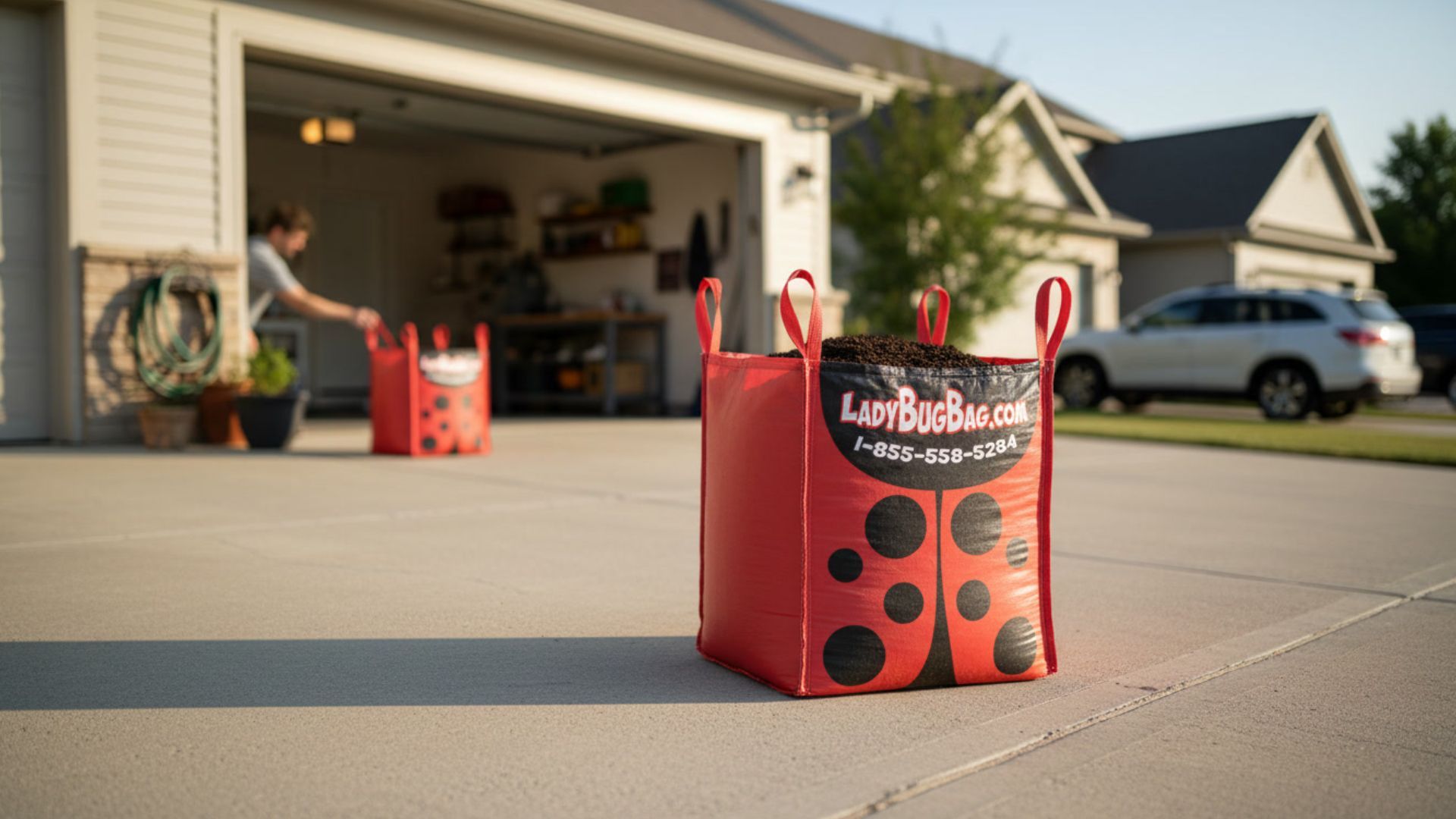
We offer soils and other garden materials in bagged formats. Our website describes one-yard bulk bags, as well as smaller bagged products in the shop. Confirm the selected product’s volume and delivery arrangements before purchasing. A calculation in cubic yards is the starting point for choosing the right package.
What are you actually filling?
Before reaching for the tape measure, describe the job. Are you filling an empty bed, adding soil above an existing surface, or replacing material you plan to remove? Those are different volumes.
For an existing garden, measure the amount you intend to add. Do not use the full depth of the garden unless you are replacing all of it. For a new raised bed, measure the interior dimensions and planned fill height.
For a lawn project, establish the required depth for your particular work before calculating. Topdressing an existing lawn and preparing a new lawn bed are different tasks. We can discuss products, but the appropriate depth should come from the project requirements.
Write the purpose next to each measurement. “Front bed: additional three inches” is more useful than “front bed: three inches,” because it tells you what the number represents.
The simple cubic-yard formula
One cubic yard contains 27 cubic feet. If all three dimensions are in feet, multiply them and divide by 27. If depth is in inches, convert it to feet first by dividing it by 12.
You can combine those two conversions into one formula: length in feet × width in feet × depth in inches ÷ 324 = cubic yards.
For example, a bed that is 12 feet long and 4 feet wide, receiving 3 inches of additional soil, needs 12 × 4 × 3 ÷ 324, or approximately 0.44 cubic yards. That is the measured volume before considering the material’s settling or the final ordering increment.
We suggest writing the units at every step. Multiplying feet by inches without conversion is a common source of oversized or undersized orders. A calculator cannot tell you that the measurements were entered in incompatible units.
How to calculate in metres
If your measurements are metric, use metres for length, width and depth. Multiply them to obtain cubic metres. Convert centimetres to metres by dividing by 100.
A bed 3 metres long and 1.2 metres wide, with a planned additional depth of 0.10 metres, requires 0.36 cubic metres. One cubic metre is approximately 1.308 cubic yards, so that example is about 0.47 cubic yards.
Alternatively, convert all dimensions into feet before using the cubic-foot formula. Either route works if you use it consistently. We recommend staying with the measurement system that feels most natural to you.
Keep a few decimal places while calculating and round the order after you have added the project areas. Rounding each small section upwards too early can create a much larger total than necessary.
Raised beds: measure inside the frame
For a raised bed, use the inside length and width. The outside dimensions include the frame material and can overstate how much soil fits.
Measure the intended fill height rather than automatically filling to the rim. If the bed already contains soil, measure the remaining space to the desired level at several points. A visibly low corner may not represent the average depth across the whole bed.
Suppose an empty bed measures 8 feet by 4 feet internally and will receive 12 inches of soil. The calculation is 8 × 4 × 12 ÷ 324, giving approximately 1.19 cubic yards.
That example does not recommend a twelve-inch depth for every raised bed. It simply shows the calculation. Planting plans, the bed design and any existing material determine the depth you actually need.
Existing garden beds: avoid ordering the full volume twice
A garden that already has a soil base may only need a limited addition. Measure the surface area and the depth you intend to add, accounting for plants and the existing grade.
If the surface varies, take several depth measurements. Record where the bed is high and low instead of using one deep spot for the whole area. For a significant slope or grading project, ask the person designing the work for the required levels.
We recommend considering where the added material will sit around established plants and structures. Do not assume that adding more soil is always beneficial or that a thicker layer suits every planting.
If you are also applying mulch, calculate it separately. Soil and mulch serve different purposes and may require different depths. Combining them into one quantity makes it difficult to order either product accurately.
Circular beds and curved borders
For a circular bed, measure the diameter and divide it by two to find the radius. Surface area is approximately 3.1416 × radius × radius. Multiply that area by the soil depth using consistent units.
A circular bed with a diameter of 10 feet has a radius of 5 feet and an area of about 78.54 square feet. Adding 3 inches of soil requires 78.54 × 3 ÷ 324, or approximately 0.73 cubic yards.
For a curved border, break the shape into manageable rectangles and triangles. A triangle’s area is half its base multiplied by its perpendicular height. Estimate gently curved sections with several narrower rectangles instead of treating every curve as a large bounding box.
We are happy to discuss a sketch with dimensions. Photos help explain the shape, but they do not replace measurements when the quantity matters.
How much area does one cubic yard cover?
Coverage changes with depth. One cubic yard contains 324 square-foot-inches of material. Divide 324 by the depth in inches to find the approximate area covered in square feet.
At a depth of 1 inch, one cubic yard covers about 324 square feet. At 2 inches, it covers about 162 square feet. At 3 inches, it covers about 108 square feet. At 6 inches, it covers about 54 square feet.
These figures describe mathematical coverage before site variation or settling. They are not planting-depth recommendations and do not promise the same finished result for every soil product.
If someone says “a yard should cover the garden,” ask at what depth. Without the depth, a coverage claim gives you only part of the information needed to order.
Add separate areas before choosing the bag count
Measure each area independently, then add their volumes. Keep areas needing different products in separate totals.
Imagine a 12-by-4-foot bed receiving 3 inches of soil and a second 6-by-3-foot bed receiving 4 inches. Their volumes are approximately 0.44 and 0.22 cubic yards. Together, the calculated requirement is about 0.67 cubic yards.
If the first bed needs one product and the second needs another, do not combine them into a single product order. Label both the volume and material choice.
We suggest keeping the unrounded calculations until the end. Once the total for each product is clear, compare it with the available package sizes and discuss any appropriate allowance for the job.
Should you allow extra soil for settling?
Loose material may settle after placement and watering, and site measurements are rarely perfect. The amount varies with the product, handling and the intended finished condition. We do not recommend applying the same percentage to every order.
Tell us whether your measurement describes loose fill or a final settled depth. That helps identify what additional information is needed. For construction or grading work, follow the project specification rather than a general garden estimate.
Ask about a practical allowance after calculating the base volume. This is more useful than adding a large amount before you know the measured requirement.
If you order extra, plan where it can be stored or used. An unnecessary surplus can create handling and placement problems, particularly on a small property or a shared driveway.
Choose the product as carefully as the quantity
Our shop includes topsoil, triple mix, black loam, manure loam and top dressing, along with mulch and aggregates. The right choice depends on your project and the existing conditions.
A product name alone does not establish that it suits every plant or construction purpose. Tell us whether you are filling a bed, refreshing an existing garden or working on a lawn. Mention any recommendations from your landscaper or garden designer.
Keep soil, mulch and aggregate calculations separate. Their quantities may all be expressed in cubic yards, but the materials are not interchangeable. A measurement worksheet should have a product column as well as an area and depth.
When you shop our soil and garden supplies, check the individual listing and package description. Confirm you are comparing like quantities, particularly when the shop includes both small bags and bulk options.
Plan where the delivery will go
A correct volume still needs an accessible delivery position. Before ordering soil delivery in Hamilton, tell us the address and proposed placement area so we can confirm availability and access.
Think about the route from the delivery point to the garden. A bag close to the work may reduce handling, but placement depends on site access and delivery equipment. Do not assume a bag can be put behind a fence or across a finished landscape without discussion.
Check gates, overhead obstructions, parked vehicles, slopes and any shared access. For a condo or managed property, confirm permission and loading requirements in advance.
For our soil delivery services in Burlington and nearby communities, the same planning applies: choose a practical location, share the details and confirm the arrangements before delivery day.
Match the delivery to your work schedule
Have a plan for moving and placing the material once it arrives. Consider the number of people helping, the tools available and how much work can realistically be done in one session.
If the project has several stages, identify which area will be completed first. Keep access to the bag available rather than allowing later materials or vehicles to block it.
Rain, garden conditions and other work on the property can affect your schedule. We recommend confirming timing and product availability as part of the order, especially if another contractor is waiting for the soil.
A bagged format helps keep the material contained, but it still needs an appropriate position. Follow any handling guidance and avoid treating a heavy bag as something that can easily be repositioned after delivery.
A measurement checklist before ordering
Start with a simple sketch and label every bed or lawn section. Write the dimensions, the intended additional depth and whether the measurements are inside a frame.
Calculate volume in a single system, convert to cubic yards where needed and add totals for each product. Mark assumptions, such as an uneven surface or unknown finished depth, so they can be clarified.
Record the selected package size separately from the calculated volume. That keeps the measurement transparent if you later change products or the available ordering increment.
Finally, include the delivery address, proposed placement location and access notes. Send us the sketch or call with the measurements if you would like help checking the arithmetic before placing the order.
Frequently asked questions
Is a cubic yard the same as a square yard?
No. A square yard measures area; a cubic yard measures volume. Soil orders need a depth as well as a surface area. We can help convert your measurements once all three dimensions are clear.
Can I calculate soil from the number of plants?
Plant count alone does not establish the volume of a bed. Measure the area and required depth. If you are filling separate planting holes, their actual dimensions and the planting requirements matter.
Should I use the outside size of a raised bed?
Use the inside measurements where the soil will sit. The frame takes up space, and existing fill reduces the additional volume needed. Measure to the desired soil level rather than automatically to the top edge.
Does one bulk bag always cover my whole garden?
That depends on the garden’s area and intended depth. Compare your calculated volume with the bag’s stated capacity. Ask us to confirm the specific product size rather than relying on a photograph.
Order with measurements you can trust
A few careful measurements can make your soil order easier to plan. Start with the purpose, measure the actual space, choose the intended depth and calculate the volume before deciding on packages.
Contact Lady Bug Bag with your Hamilton or Burlington project details. We can discuss the available products, help check the quantity calculation and confirm delivery arrangements for your address.